 Aster
Aster Spot Trading Alongside Leveraged Perpetuals
Updated -
Aster is a decentralized exchange for spot tokens and margin-backed perpetual contracts, whose leveraged positions face liquidation under product-specific margin rules. Its order-book markets, Shield Mode, and 1001x use different execution models. The platform also includes yield products and its own trading-focused blockchain. Trading access, accepted collateral, and privacy protections vary by product and account settings.
Order execution depends on liquidity or pool pricing, while collateral determines which balances support a position. Products within the same platform can have different funding, privacy, and withdrawal rules, so the selected trading mode determines which conditions apply.
Aster's order-book margin settings determine whether positions share account collateral or use margin allocated to an individual position.
Spot balances and perpetual exposure
Spot trading changes the tokens held in an account, while a perpetual contract creates long or short exposure to an underlying price. Perpetual positions require continuing margin support. Order-book funding payments help connect perpetual prices with spot markets. A short contract position can express exposure to falling prices without holding the underlying token. Holding a token and holding a leveraged contract therefore create different obligations, even when both track the same market.
Market coverage extends beyond crypto perpetuals to stock- and commodity-linked contracts. The spot market also includes bStocks, which provide synthetic exposure to stocks and exchange-traded funds. Owning these tokens does not confer shareholder voting rights. Corporate-action processing can temporarily interrupt trading or related services.
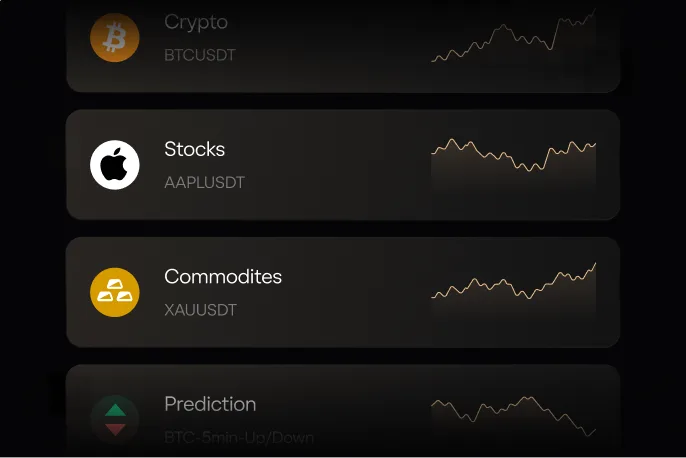
Aster Predictions trades shares in defined event or price outcomes. Each market has its own settlement window and rules. Price markets resolve against a spot-index measure, while event markets resolve against the event's outcome. Prediction holdings appear separately from perpetual positions.
Order-book execution and strategy tools
Order-book trading combines price instructions with liquidity matching; Aster Pro's perpetual interface includes execution tools for managing orders and positions.
Market and limit orders
Market orders take available liquidity, and their fill price reflects the depth available during execution. A limit order specifies the maximum purchase price or minimum sale price, and may remain unfilled without matching liquidity. A stop-limit order activates a limit order after its trigger condition occurs, so activation does not establish a completed fill.
Hidden orders and positions
Pro hidden orders keep limit-order details out of the public book while sharing liquidity with ordinary orders. Positions opened through them stay outside public position feeds. Matching, margin, and liquidation still use the complete position size. Concealment changes visibility; it does not reserve a counterparty or remove the contract's margin requirements.
Orders spread through time or price
TWAP (time-weighted average price) divides an order into smaller executions over time. Grid strategies place buy and sell orders at preset price intervals and support neutral, long, or short positioning. Scaled orders distribute limit orders across a selected price range. For a TWAP that opens exposure, failing a sub-order margin check terminates the strategy; reduce-only orders do not undergo that check.
Shield Mode and 1001x liquidity
Shield Mode and 1001x provide alternatives to the order book, with their own pricing mechanics and collateral requirements.
Shield pricing and fee choices
Shield Mode has a simplified interface with order and position privacy. Its dynamic slippage responds to order size, directional open-interest imbalance, and market depth. Open interest measures outstanding contracts, so exposure on either side affects the price adjustment. The pricing mechanism applies a configured minimum slippage when that exceeds calculated market impact. Its profit-share option charges a percentage of profitable positions' earnings, while its flat-fee option charges position notional.
Pool-backed perpetual trading
1001x trades supported markets on BNB Chain and Arbitrum using onchain liquidity supplied through ALP. This product supports direct wallet-based trading without a separate account deposit. Maximum leverage varies by supported market and mode; the product name is not a universal setting. Execution depends on pool liquidity and oracle pricing, with margin exposed to leveraged losses.
Margin settings and liquidation exposure
Pro's order-book margin settings determine how positions share collateral and how much of that collateral a loss can affect.
Shared and allocated margin
Cross margin pools eligible funds across open positions. Gains from one position can support another, and losses can consume their shared buffer. Isolated margin allocates collateral to a particular position. The allocation applies to the trading account; connecting a wallet alone does not place every wallet asset into margin.
| Order-book margin setting | Collateral allocation |
|---|---|
| Cross-margin allocation | Eligible margin is shared among open positions in the trading account. |
| Isolated-margin allocation | Each position uses its own allocated margin, separate from other positions. |
| Multi-Asset Mode allocation | Supported collateral shares cross margin; this mode does not support isolated margin. |
Reference prices and maintenance requirements
Pro's order-book perpetual positions face liquidation when their margin falls below the maintenance requirement. The mark price supplies the liquidation reference and unrealized profit-and-loss valuation; the last price reflects the latest contract trade. Initial margin is position notional divided by leverage, while maintenance requirements follow position size and risk tier. Collateral valuation ratios determine how much asset value counts as usable margin. In Multi-Asset Mode, collateral-price changes can alter margin support without a new trade. That mode also permits automatic asset conversion under its negative-balance and liquidation rules.
Under Multi-Asset Mode, hourly interest applies only to the portion of each USDT or USD1 deficit that exceeds its separately applied interest-free threshold.
Aster Earn and trading collateral
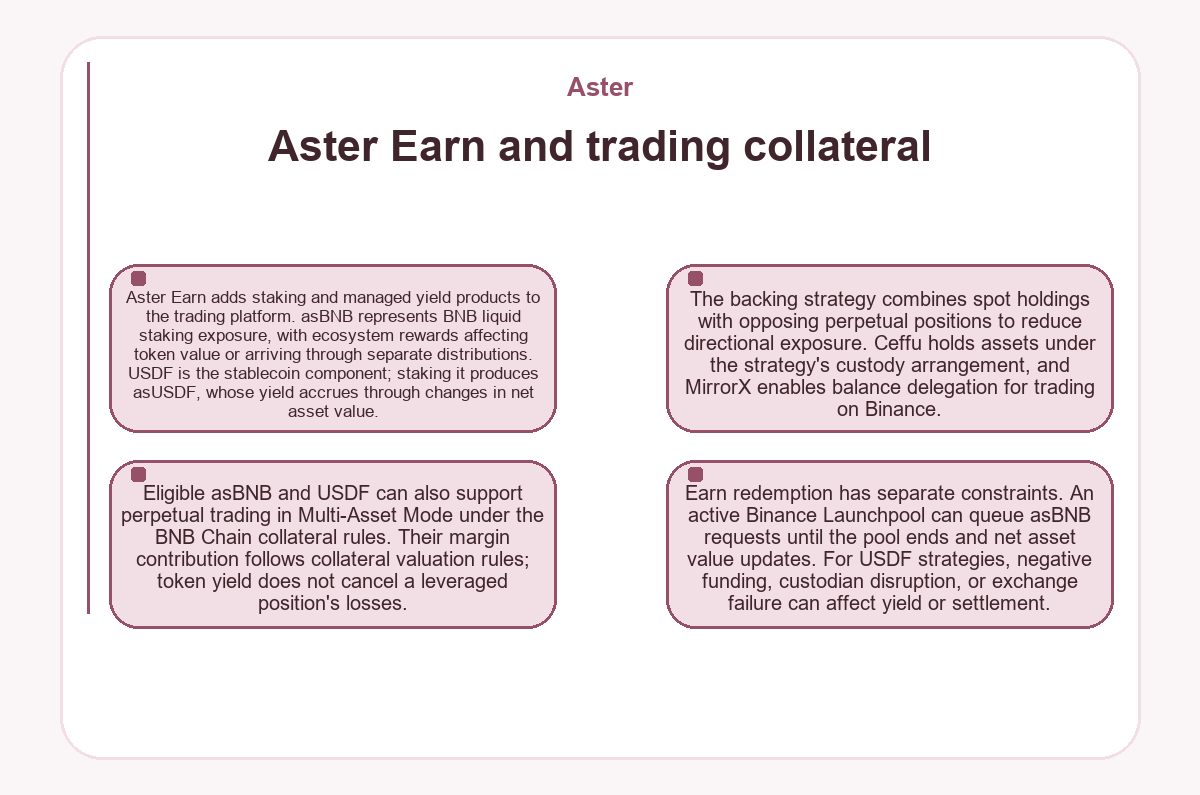
Aster Earn adds staking and managed yield products to the trading platform. asBNB represents BNB liquid staking exposure, with ecosystem rewards affecting token value or arriving through separate distributions. USDF is the stablecoin component; staking it produces asUSDF, whose yield accrues through changes in net asset value. The backing strategy combines spot holdings with opposing perpetual positions to reduce directional exposure. Ceffu holds assets under the strategy's custody arrangement, and MirrorX enables balance delegation for trading on Binance.
Eligible asBNB and USDF can also support perpetual trading in Multi-Asset Mode under the BNB Chain collateral rules. Their margin contribution follows collateral valuation rules; token yield does not cancel a leveraged position's losses. Earn redemption has separate constraints. An active Binance Launchpool can queue asBNB requests until the pool ends and net asset value updates. For USDF strategies, negative funding, custodian disruption, or exchange failure can affect yield or settlement.
Aster Chain, account privacy, and token staking
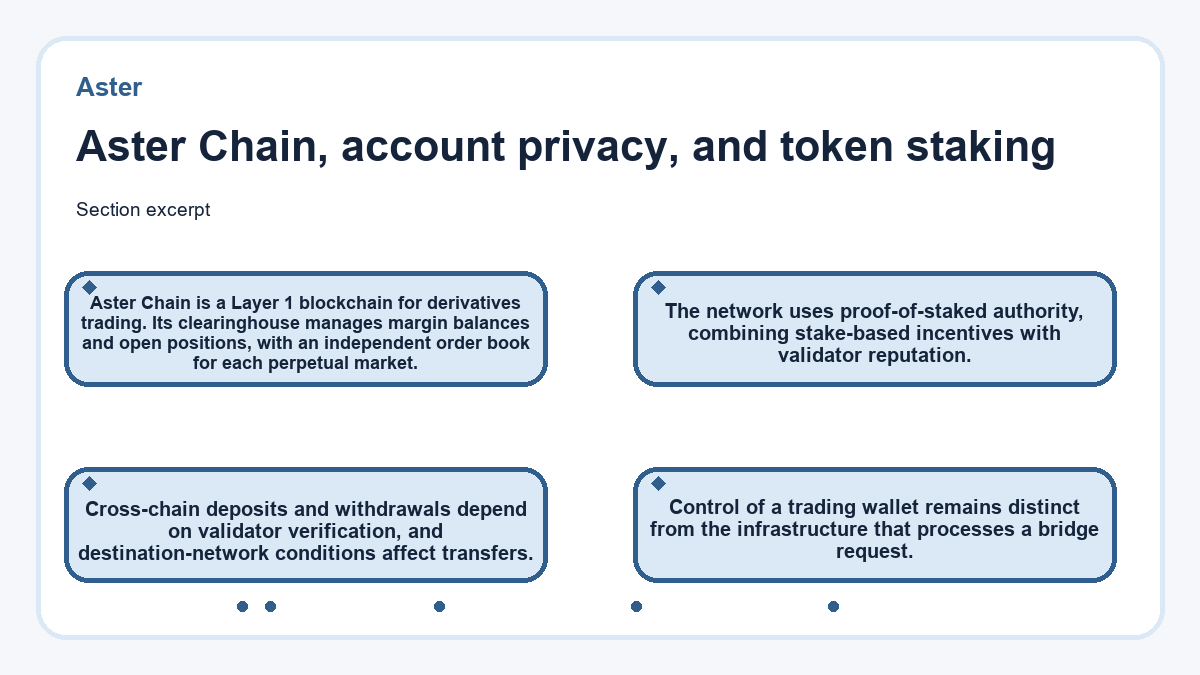
Aster Chain is a Layer 1 blockchain for derivatives trading. Its clearinghouse manages margin balances and open positions, with an independent order book for each perpetual market. The network uses proof-of-staked authority, combining stake-based incentives with validator reputation. Cross-chain deposits and withdrawals depend on validator verification, and destination-network conditions affect transfers. Control of a trading wallet remains distinct from the infrastructure that processes a bridge request.
Account Privacy controls public visibility on the chain. With it disabled, trading activity is public; enabling it hides asset balances and open positions. Privacy in public order and fill data applies to orders placed after activation. Orders completed while privacy was disabled remain visible. Account Privacy combines encrypted orders with zero-knowledge verification and one-time stealth addresses for trades. A viewer pass permits selective disclosure, so sharing it affects confidentiality. Internal transfers to other users are unavailable while Account Privacy is active. These settings are separate from the hidden-order option in Pro.
ASTER staking delegates tokens to validators and ties rewards to validator contribution, delegation size, and lock conditions. Longer locks affect loyalty reward weight, and exiting before a lock expires incurs a penalty based on its remaining duration. Validator commission reduces the rewards shared among delegators.
Account access and trading costs
Wallet access requires a compatible connection and a funded balance for products that use exchange accounts. Aster also supports email login, which creates an email-linked wallet. The minimum user age is 18, and geographic restrictions apply regardless of the sign-in method.
Email-linked wallets accept only USDT deposits through Arbitrum One. This restriction belongs to that login route and does not describe every wallet-based product.
Order-book trading fees distinguish makers, which add resting liquidity, from takers, which match existing orders. The applicable schedule also depends on product, market category, and qualifying fee tier. Crypto perpetual groups and real-world-asset markets can follow different schedules. Spot fees have a separate schedule, and ASTER payment can change qualifying spot charges. Spread and slippage affect execution economics independently of these fees. Destination-chain charges also matter when withdrawing funds.
On Aster Pro, perpetual funding transfers value between long and short holders at the market's applicable interval, without going to the exchange. Positive funding makes longs pay shorts; negative funding reverses the direction. Funding can reduce account or position margin, so a holding-cost estimate needs the current interval and rate alongside the opening and closing charges.
Questions and answers about Aster
How are Astherus and APX related to Aster?
Aster emerged from the combination of Astherus and APX in March 2025. Those names refer to predecessor projects in the exchange's history. ASTER is the ticker of the ecosystem token.
Is Aster available to residents of the United States?
Aster's access terms exclude residents of the United States. The restriction also covers users located there and specified entities established there. Canada and the United Kingdom are among the other prohibited jurisdictions. Connecting a wallet or creating an email-linked account does not override these restrictions or establish eligibility.
Which token does an asBNB redemption return?
Redeeming asBNB through Aster Earn returns slisBNB, including when the original mint used BNB. Canceling a queued mint also returns slisBNB. An active Binance Launchpool can delay processing until the pool ends and the net asset value updates.
Can spot trading fees be paid with ASTER?
Spot trading fees can be paid with ASTER when the payment setting is enabled and the spot wallet holds enough tokens. The published option gives a 5% discount on qualifying trading fees. This payment choice is separate from the VIP tier that determines the underlying trading rate.
What can prevent a Pro withdrawal despite positive collateral value?
An unresolved negative asset balance can block a withdrawal from the Pro perpetual account. Realized losses, funding payments, and commissions can create that debt when other assets supply collateral. Positive collateral value does not settle an individual asset deficit. The account needs to settle that asset deficit before withdrawing funds.