 Aster
Aster
Aster fees combine market-specific trading charges and distinct perpetual holding costs
Updated -
Aster fees depend on the trading product, market category, and whether an order adds or removes liquidity. Order-book perpetuals have zero maker fees, with a 0.04% base taker rate for General crypto contracts and separate schedules for Group B and RWA markets. Spot trading, Shield Mode, and 1001x use different charging rules. Funding adds a holding-cost component, whose timing and calculation depend on the perpetual product.
Order-book markets and their rate schedules
Aster separates its order-book fee schedules by market category, so the contract's underlying exposure and quote asset help determine the applicable trading rate. General crypto and Group B contracts have different taker schedules. Contracts based on real-world assets, or RWA, carry a uniform taker rate across VIP levels. USD1-quoted contracts retain a distinction between crypto exposure and RWA exposure.
| Order-book market | Trading rates before fee-payment discounts | Contract or asset scope |
|---|---|---|
| General crypto perpetuals | 0% maker; 0.04% base taker, with VIP reductions | Crypto contracts in the General category |
| Group B crypto perpetuals | 0% maker; 0.1% base taker, with VIP reductions | Selected crypto contracts assigned to Group B |
| RWA perpetuals | 0% maker; 0.0125% taker across VIP levels | Real-world asset contracts, including USD1 quotes |
| USD1 crypto perpetuals | 0% maker; 0.04% base taker, with VIP reductions | BTC, ETH, and SOL contracts quoted in USD1 |
| Spot trading | Base rates: 0.005% maker and 0.04% taker; VIP terms apply | Spot token markets under their pair-specific terms |
The RWA taker rate of 0.0125%, equivalent to 1.25 basis points, took effect on September 7, 2026.
Quote currency alone does not establish a cheaper perpetual rate. The USD1 crypto schedule uses the General base taker rate, while USD1 RWA contracts follow RWA pricing. Spot has its own maker commission. Shield Mode and 1001x attach separate charging rules to their position models.
How does a fill become a maker or taker charge?
A fill receives the maker rate when a resting order supplies liquidity, or the taker rate when it immediately consumes existing liquidity. A limit instruction can incur taker fees if its price matches an order already resting in the book. The limit label controls price, while the execution determines the liquidity role.
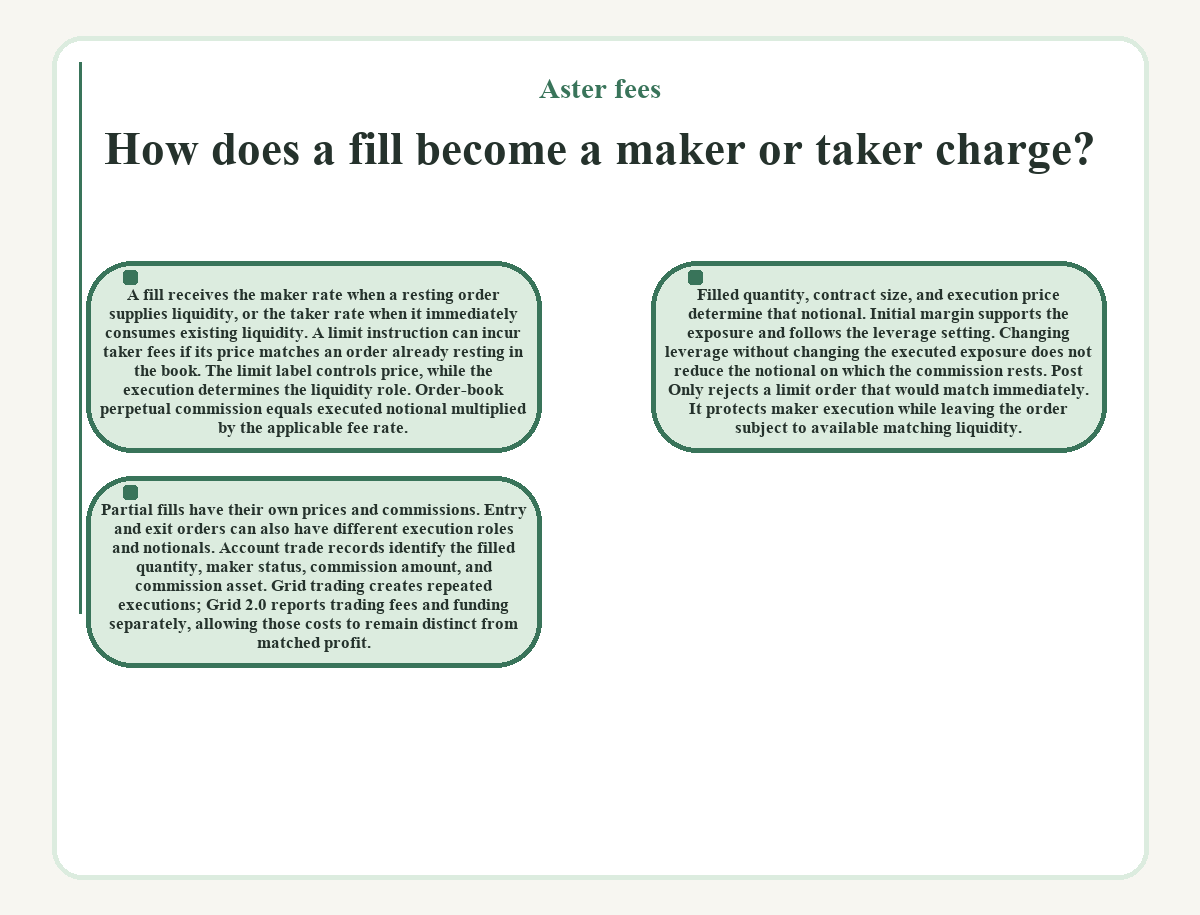
Order-book perpetual commission equals executed notional multiplied by the applicable fee rate. Filled quantity, contract size, and execution price determine that notional. Initial margin supports the exposure and follows the leverage setting. Changing leverage without changing the executed exposure does not reduce the notional on which the commission rests.
Post Only rejects a limit order that would match immediately. It protects maker execution while leaving the order subject to available matching liquidity.
Partial fills have their own prices and commissions. Entry and exit orders can also have different execution roles and notionals. Account trade records identify the filled quantity, maker status, commission amount, and commission asset. Grid trading creates repeated executions; Grid 2.0 reports trading fees and funding separately, allowing those costs to remain distinct from matched profit.
VIP eligibility and fee-payment balances
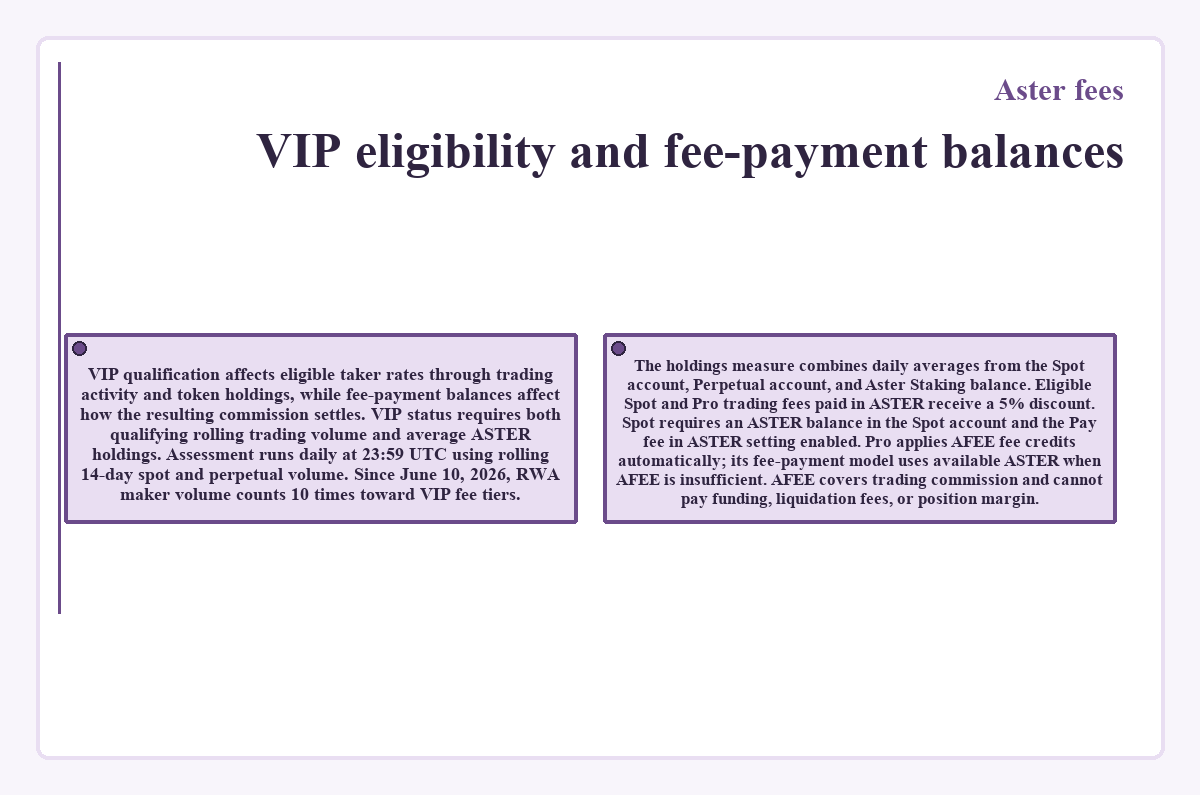
VIP qualification affects eligible taker rates through trading activity and token holdings, while fee-payment balances affect how the resulting commission settles. VIP status requires both qualifying rolling trading volume and average ASTER holdings. Assessment runs daily at 23:59 UTC using rolling 14-day spot and perpetual volume. Since June 10, 2026, RWA maker volume counts 10 times toward VIP fee tiers. The holdings measure combines daily averages from the Spot account, Perpetual account, and Aster Staking balance.
Eligible Spot and Pro trading fees paid in ASTER receive a 5% discount. Spot requires an ASTER balance in the Spot account and the Pay fee in ASTER setting enabled. Pro applies AFEE fee credits automatically; its fee-payment model uses available ASTER when AFEE is insufficient. AFEE covers trading commission and cannot pay funding, liquidation fees, or position margin.
When does an order-book position incur funding?
Order-book perpetual funding settles at the contract's funding time for positions held through the collection window, which can have a 15-second timing deviation; the default interval is eight hours, although contracts can use different intervals. Aster can adjust intervals, caps, and floors in response to market conditions.
Order-book perpetual funding passes between long and short traders. Positive rates charge longs and credit shorts; negative rates reverse that direction. Aster does not charge or receive this transfer. The funding amount equals position size multiplied by mark price and the applicable funding rate.
Funding uses mark-price notional, while trading commission uses execution notional. Rates with different settlement intervals describe different holding periods. Comparing cumulative funding requires matching those periods and accounting for the actual rates and position values at each settlement.
Shield Mode and 1001x charging rules
Shield Mode offers profit-sharing and flat-fee pricing, so a charge based on profit uses a different denominator from a charge based on position notional. The standard profit-sharing schedule takes 15% to 20% of a profitable position's profit; a losing position incurs no profit-sharing charge. The standard flat-fee schedule charges 0.03% of position notional on opening and closing. An applicable temporary fee waiver can override those opening and closing commissions. Funding and slippage remain separate cost components.
Shield funding follows its own open-interest imbalance formula, and Aster collects the charge under that model. Payments arise at hourly settlement boundaries. The funding parameter, floor, and cap can change with market conditions. Selecting profit-sharing changes the commission basis while the hourly funding mechanism continues to govern the cost of maintaining Shield exposure.
The standard 1001x crypto schedule charges 0.08% on opening and 0.08% on closing, calculated against entry and exit notional respectively. 1001x forex perpetuals charge 0.02% on opening and closing and are available only on BNB Chain. An opening-only execution fee covers network costs and adds to the trading commission. The execution schedule specifies $0.50 on BNB Chain and $0.20 on Arbitrum. These network-specific charges belong to 1001x and do not describe the order-book maker or taker schedule.
The 1001x high-leverage fee model uses zero opening trading commission for positions at 500x, 750x, or 1001x leverage, and applies a dynamic closing fee. The closing rate is the larger of two values: realized profit or loss multiplied by the share rate and divided by opening notional, and the minimum closing rate. The documented default share rate is 15%, with an initial minimum closing rate of 0.03%. The opening execution fee remains separate. Holding costs combine an open-interest imbalance component with a borrow rate. Funding accumulates per block, enters unrealized profit and loss, and affects the liquidation price.
Slippage, transfers, and capital requirements
Slippage changes the execution price independently of the commission rate, while margin requirements determine the capital that supports the position. Order-book fills reflect available liquidity at execution. Shield uses dynamic slippage based on liquidity and open interest. The 1001x model uses fixed or dynamic slippage by pair; its dynamic calculation also considers new position size and pool exposure. A lower commission can coincide with a less favorable fill price.
Initial margin is capital allocated to support leveraged exposure. An adverse difference between the order price and mark price can require an opening-loss buffer in addition to that margin. Pro withdrawals can deduct network gas costs from the withdrawal amount. Forced settlement can also incur liquidation fees under the contract's Trading Rules. A maker exit can reduce commission relative to a taker exit, while an unclosed position remains subject to its contract's funding rules.
Aster fees: what people ask
Do pending orders reduce the ASTER holdings used to qualify for VIP fees?
ASTER held in pending orders remains included in the VIP balance calculation. Aster averages hourly balance snapshots across the Spot account, Perpetual account, and Aster Staking balance. Each account's daily average uses 24 snapshots, taken at random times within the respective hours. The calculation measures average holdings, so an end-of-day balance alone does not establish qualification.
Which trading charge appears as an Insurance Clearance Fee?
An Insurance Clearance Fee records the portion of a Pro liquidation fee allocated to the insurance fund. It belongs to forced liquidation accounting and is separate from ordinary maker or taker commission. The contract's Trading Rules determine the applicable liquidation fee tiers, so a standard trading rate does not describe this charge.
Does matching my own futures orders avoid Aster trading fees?
Matching your own futures orders can still incur the applicable taker commission. Self-Trade Prevention handles eligible matching futures orders according to the configured cancellation policy. It excludes Fill or Kill (FOK) and Post Only (GTX) orders. Its scope includes orders within one futures account and orders among a master account and its subaccounts. The feature acts on remaining unfilled quantity; it does not reverse portions that already executed.
Are AFEE and BonusUSD interchangeable for paying trading costs?
AFEE and BonusUSD have different functions in Aster Pro. AFEE offsets trading commission and cannot support a position as margin. BonusUSD is futures collateral that requires Multi-Asset Mode and is available on BNB Chain. The bonus balance cannot be withdrawn, although profits generated through eligible trades can be withdrawn.
Where does Aster take funding payments when the Perps Account balance is insufficient?
Aster can deduct an order-book funding payment from position margin when the Perps Account balance is insufficient. That deduction can change the liquidation price by reducing the capital supporting the position.
Is the account's USDT-USDC swap charged at spot maker or taker rates?
The in-account stablecoin swap uses a separate 0.1% standard conversion fee. It covers USDC to USDT and the reverse direction, plus USDC.e to USDT and the reverse direction. This conversion does not use the order book. USDC denotes native Ethereum USDC, and USDC.e denotes bridged USDC on Arbitrum. The May 11 through June 10, 2026 promotion waived this conversion fee during that period.